Unlocking AGV/AMR Performance: A Deep Dive into Low-Resistance and Shock-Absorbing Casters
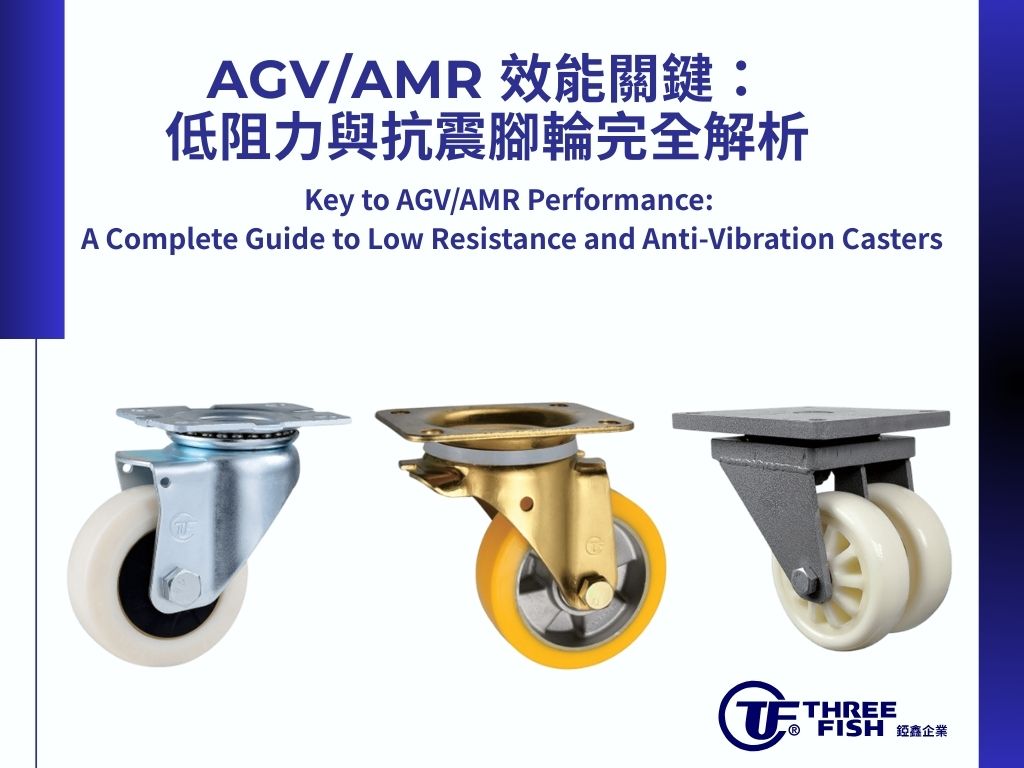
In the era of Industry 4.0 and Logistics 4.0, AGVs (Automated Guided Vehicles) and AMRs (Autonomous Mobile Robots) have become standard equipment in modern factories and warehouses. However, most System Integrators (SIs) and engineers tend to focus 80% of their efforts on optimizing LiDAR navigation, algorithms, and battery life.
Yet, many overlook a critical physical reality: every command and movement an AGV executes must ultimately be translated through the wheels in contact with the ground. Choosing the wrong caster can increase power consumption by over 30%, cause frequent positioning errors, and even damage delicate sensors due to excessive vibration.
This article explores how to select the optimal casters for automation equipment from the perspectives of material science and mechanical structure, achieving the goals of low energy consumption, high precision, and long service life.
The 3 Technical Pillars of AGV-Specific Casters
For automation equipment operating 24/7, standard industrial casters simply cannot make the cut. Focus must be placed on these three core technical indicators:
1. Rolling Resistance & Starting Force: The Battery Life Killers
The most power-intensive moments for an AGV are not during constant-speed travel, but during starting and turning.
-
The Challenge (Starting Resistance): When a 500 kg AGV is stationary, gravity causes the wheels to settle, creating a "flat spot" on the floor. If the wheel material lacks sufficient resilience, the motor requires massive torque just to "climb out" of this depression, causing a spike in current draw.
-
The Solution: Utilize High-Rebound Polyurethane (PU). This material features extremely low Hysteresis Loss, meaning it rapidly returns the energy of deformation, significantly reducing rolling resistance.
-
TFCaster's Insight: We recommend our European-style Aluminum Core PU Series. The aluminum alloy core offers lightweight performance and excellent heat dissipation, preventing tread delamination or deformation caused by thermal buildup.
2. Offset (Swivel Lead) & Steering Agility
When an AGV performs 90-degree turns or 360-degree spins in narrow aisles, the design of the caster's Offset (also known as Swivel Lead) is critical.
-
The Technical Trade-off: If the offset is too large, the caster turns easily but may cause "shimmying" or "wobble" during straight-line travel, affecting LiDAR positioning. If the offset is too small, steering resistance increases, placing a heavier load on the motors.
-
The Solution: A precisely calculated Short Offset paired with a Thrust Bearing. This combination ensures smooth rotation under heavy loads while maintaining excellent tracking stability during straight-line movement.
3. Shock Absorption & Ground Contact: Protecting the "Brain"
Modern AMRs are equipped with expensive lenses and sensors. On uneven surfaces, the impact force transmitted by rigid wheels can loosen electronic components or cause data drift.
-
The Solution: Implement Spring-Loaded (Shock Absorbing) Casters. Using springs or polymer damping structures to absorb impact ensures that all four wheels remain in constant contact with the ground, preventing wheel lift (traction loss) that leads to navigation errors.
TFCaster Solutions: Engineered for Automation
Targeting the automated warehousing and robotics industries, TFCaster has developed specific solutions:
-
Heavy-Duty Automation Preferred: The [King Kong Series] and [Clouded Leopard Series] are designed specifically for AGVs carrying multi-ton loads.
-
Specialized Material Applications: Our European Aluminum Core PU Series is ideal for electronics factories (eliminating static electricity) and offers industry-leading low rolling resistance for long-distance travel.
-
Pro Tip: When selecting casters, always reserve a 20%~30% safety load factor to account for dynamic loads generated during emergency braking and high-speed cornering.
Conclusion
Optimizing AGV performance isn't just about software; hardware - specifically the casters - is the critical "last mile" of implementation. A high-quality set of casters makes robots more energy-efficient, stable, and durable.
With over 30 years of manufacturing experience, TFCaster provides not just a product, but a "Mobility Efficiency Optimization Solution."
Optimize Your Automation Equipment Today: [Contact TFCaster]
Frequently Asked Questions (FAQ)
Q1: Why do AGV wheels often suffer from "delamination" (tread separation)? A: This is often due to heat buildup from continuous operation that cannot dissipate. We recommend switching to the Aluminum Core PU Series. Aluminum dissipates heat rapidly and forms a stronger chemical bond with the PU, significantly reducing the risk of delamination.
Q2: My factory has Epoxy flooring. Which wheels won't leave marks? A: You must use high-quality PU (Polyurethane) or TPR materials. Absolutely avoid standard black rubber wheels, as they leave carbon black skid marks that are difficult to clean.
Q3: How do I know if my AGV needs "Shock Absorbing Casters"? A: If your AGV carries precision instruments (like wafer cassettes) or operates on floors with gaps/uneven surfaces (like elevator thresholds or expansion joints), the Shock Absorbing Series is strongly recommended.
Q4: Are Conductive (ESD) wheels mandatory for AGVs? A: In semiconductor plants, electronic assembly lines, or environments with flammable gases, ESD wheels are essential to prevent electrostatic discharge from damaging circuit boards or causing sparks.
Q5: Can TFCaster customize AGV wheels? A: Yes. Whether it's installation height, offset adjustments, or special tread formulas for specific environments, our R&D team can engineer a tailored solution for you.