Plastic vs. Stainless Steel Dollies: The Ultimate Buying Guide
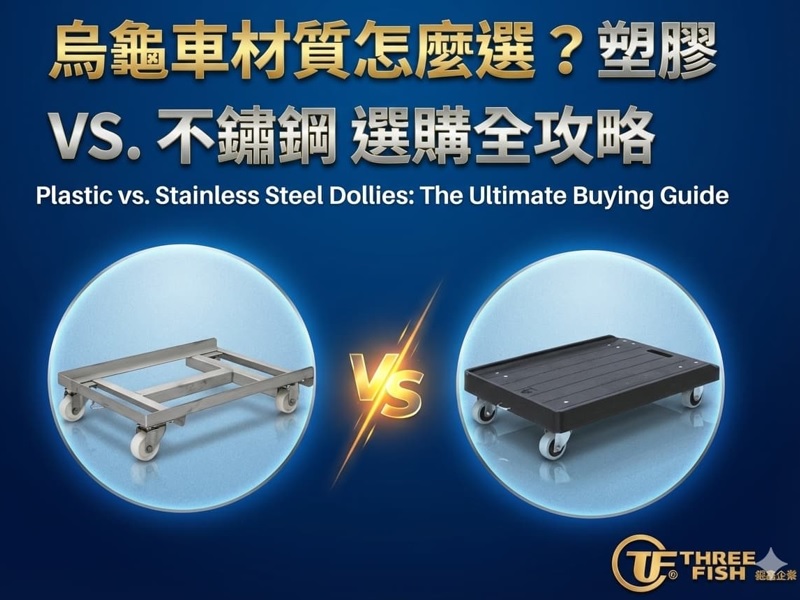
In the daily operations of any factory, warehouse, or office, material handling is often the most labor-intensive and time-consuming process. This is where the small but mighty flatbed dolly - affectionately known in Taiwan as the "Turtle Cart" becomes an indispensable tool.
Many people assume that "any dolly will do." However, have you ever encountered these frustrations?
-
Excessive Noise: The wheels are so loud they disrupt the entire floor.
-
Hard to Push: The wheels buckle under heavy loads, causing high start-up resistance and back pain for employees.
-
Hygiene Issues: Using wooden dollies in food processing plants leads to mold and failed safety audits.
-
Size Constraints: Cargo is slightly larger than the cart, but the handle gets in the way, making it impossible to load.
As a professional manufacturer of casters and material handling equipment, TFCaster is here to guide you. Today, we will help you choose the best dolly for your industry, focusing on the two main material contenders: Engineering Plastic and Stainless Steel.
1. What is a "Turtle Cart" (Dolly)? Why is it the MVP of Logistics?
The technical term is a Flatbed Dolly, Pallet Dolly, or simply a Dolly.
Why do we call it a "Turtle Cart" in Taiwan? Because of its low profile and four wheels firmly on the ground, carrying cargo on its back just like a steady, moving turtle. While the structure is simple a platform plus four casters it plays a critical role in keeping cargo off the floor and moving heavy loads with ease.
Three Key Features of a Premium Dolly:
-
Extreme Efficiency: Superior wheel design allows a single person to push a 100kg load with one hand.
-
Space Magician: Designed for stacking/nesting when not in use, saving valuable warehouse floor space.
-
Agile Maneuverability: Equipped with 360-degree swivel casters to navigate through narrow aisles effortlessly.
2. The Ultimate Choice: Dolly vs. Folding Handle Cart
When purchasing handling equipment, many people instinctively choose an L-shaped Cart (Folding Handle Platform Truck) because they believe a handle makes it easier to push. However, in many professional environments, the handle-less Dolly is actually the superior choice.
Why? Because sometimes, a handle is a limitation.
1. Who needs a Dolly?
If you fit any of the following descriptions, a flatbed dolly is better for you than a handle cart:
-
You move irregular or oversized cargo: The handle on a platform truck limits the cargo size. If you are moving long sofas, wide machinery, or large display racks, the dolly's "borderless design" allows cargo to extend beyond the edge of the platform without restriction.
-
You need to stack logistics boxes: Logistics companies, convenience store distribution, and central kitchens often use standardized logistics baskets. These are designed to stack 5-6 layers high. With a dolly, you can slide the entire stack on directly. With a handle cart, the handle often interferes with the top baskets, and you cannot place multiple carts tightly together.
-
You are extremely short on storage space: Even when folded, platform trucks take up significant floor space. TFCaster's plastic dollies feature a "Cross-Stacking" design. You can stack 10 dollies vertically, standing less than 100cm high, taking up almost no walkway space.
2. Quick Comparison: Dolly vs. Folding Handle Cart
| Feature | Dolly (Turtle Cart) | Folding Handle Cart |
|---|---|---|
| Appearance | Flat platform, no handle, usually 4 swivel casters | Has a handle (fixed or foldable) |
| Biggest Advantage | Unlimited: Cargo can overhang the platform | Control: Handle offers directional stability |
| Cargo Size | Unlimited (Can exceed platform size) | Restricted (Blocked by the handle) |
| Storage | Stackable vertically; saves immense space | Still occupies floor space when folded |
| Terrain | Flat floors, indoor aisles, elevators | Can handle slightly rougher surfaces |
| Best For | Movers, Logistics, Food/Bakery, Exhibitions | Office mailrooms, Couriers, Home use |
3. Material Showdown: Plastic vs. Stainless Steel
Once you've decided on a dolly, the next step is the material. Traditional wooden dollies are becoming obsolete due to rot and moisture issues. The current industrial standards are High-Performance Engineering Plastic and 304 Stainless Steel.
1. Plastic Dollies (Lightweight & Mainstream)
This is the most common choice for logistics centers and factories. Note: We aren't talking about cheap, brittle plastic. TFCaster uses Impact-Resistant PP (Polypropylene) or Reinforced Nylon.
-
Lightweight & Portable: Easy to carry by hand; female employees can operate them with ease.
-
Washable & Rust-Free: Unlike steel carts, plastic is impervious to water, making it suitable for damp environments.
-
Recommended For: Electronics factories, logistics warehouses, retail distribution, offices.
2. Stainless Steel Dollies (The Hygiene Expert)
If your environment requires high cleanliness standards or involves water, acids, or alkalis, a full 304 Stainless Steel dolly is the only solution.
-
HACCP/GMP Compliant: The smooth, non-porous surface of food-grade 304 stainless steel prevents bacterial adhesion and withstands high-temperature steam cleaning or alcohol disinfection.
-
Corrosion Resistance: Withstands salt in central kitchens or chemicals in processing plants without rusting.
-
Durability: High structural integrity; resists deformation under heavy loads over time.
-
Recommended For: Central kitchens, food processing, pharmaceuticals, biotech labs, cleanrooms, meat/seafood processing.
4. The Soul of the Cart: The Casters
Many buyers look at the platform but ignore the most important part: The Casters. As caster manufacturing experts, we emphasize: Whether a cart is easy to push depends entirely on the wheels.
We typically offer three wheel options:
A. TPR / PU Wheels (Quiet & Floor Protection)
-
Features: Elastic tread, good grip, and very quiet operation.
-
Best Surface: Epoxy flooring, tile, polished indoor floors.
-
Benefit: "Floor protection" is the key selling point. No scratches and no loud rumbling noise.
B. Nylon / PP Wheels (Fast, Effortless & Durable)
-
Features: Hard texture, low friction coefficient, extremely low rolling resistance.
-
Best Surface: Concrete, asphalt, carpet, or dirty environments with oil/grease.
-
Benefit: Wear-resistant and withstands chemical hydrolysis. If your priority is "effortless pushing," choose hard nylon wheels.
C. Conductive Wheels (Special Requirement)
-
Features: Directs static electricity from the cart to the ground.
-
Best Surface: Semiconductor factories, precision electronic assembly lines.
5. Selection Checklist: 4 Steps to the Best Buy
Confused by the options? Just follow this checklist:
-
Step 1: Check Environment & Hygiene
-
High humidity, chemicals, or food contact? ➡ Stainless Steel Dolly.
-
General warehousing or logistics? ➡ Engineering Plastic Dolly.
-
-
Step 2: Check Cargo Size
-
Is the cargo size fixed (e.g., standard logistics boxes)? ➡ Standard size dolly.
-
-
Step 3: Check Floor Material
-
Epoxy (green) floors that scratch easily? ➡ Specify TPR or PU Wheels.
-
Rough concrete floors? ➡ Specify Nylon Wheels.
-
-
Step 4: Check Load Capacity
-
How heavy is the load? Always reserve a 20% safety margin.
-
6. FAQ
Q1: Will plastic dollies become brittle after sun exposure?
A: Cheap plastic will. However, TFCaster uses UV-resistant and impact-resistant Engineering PP/Nylon. They offer excellent weather resistance for mixed indoor/outdoor use.
Q2: My dolly's wheels are broken. Can I replace just the wheels?
A: Absolutely! This is the benefit of choosing a professional manufacturer. We provide complete spare parts. You don't need to throw away the whole cart; just replace the casters with the same specifications, and it will be as good as new.
Q3: Can Stainless Steel dollies go into the freezer?
A: Yes, 304 stainless steel withstands low temperatures. However, the key is the wheels. If entering freezers below -20°C, please inform us. We must install Cold-Resistant Casters (Cryogenic Casters) to prevent standard rubber wheels from freezing and cracking.
7. Conclusion: Upgrade Your Efficiency Starting with a Good Dolly
In modern logistics, "saving effort" equals "saving money."
Using an old cart with stuck wheels not only causes employee fatigue and injury (potential labor costs) but also slows down your turnover rate.
With decades of caster manufacturing experience, TFCaster's dolly series is designed not just to carry goods, but to optimize your workflow. Whether you need a lightweight plastic dolly or a food-safe stainless steel model, we have the professional solution.
Want to improve factory handling efficiency? Stop letting your employees struggle with heavy, clumsy carts.
Browse TFCaster's Full Series of Hand Trucks & Dollies Have special specifications? Contact our technical team directly for the best wheel configuration recommendations!