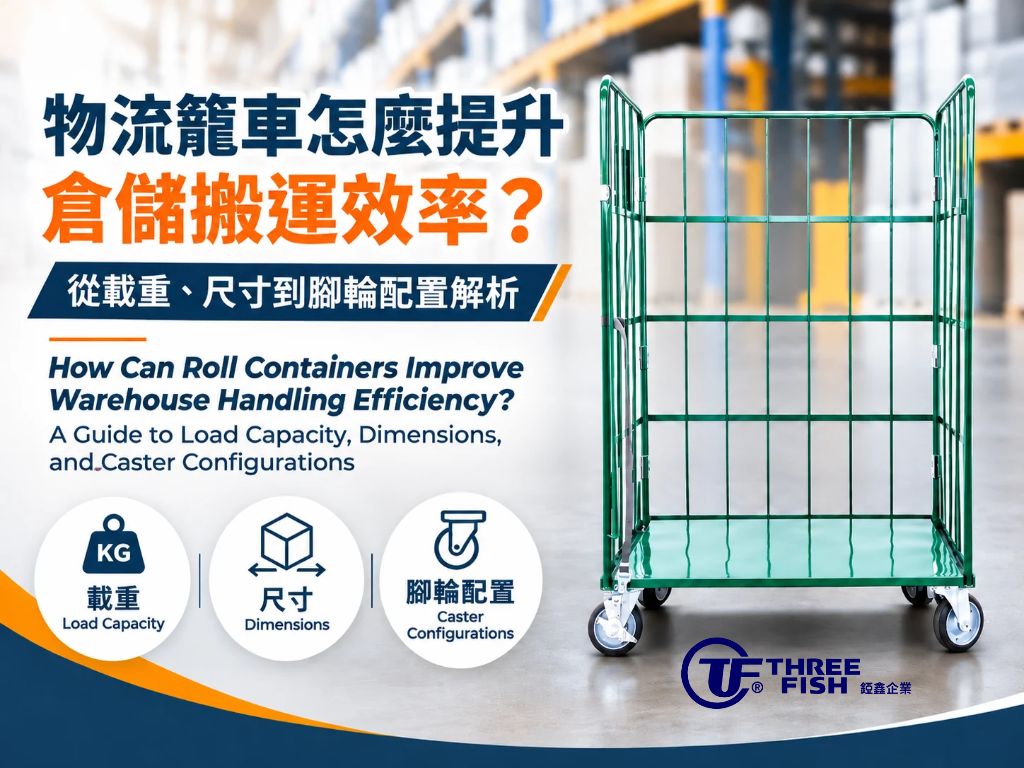
Logistics roll cages are essential material handling equipment widely used in warehousing, distribution centers, retail restocking, and factory material turnover. They allow for the consolidated loading of multiple items, significantly reducing the frequency of manual transport. However, if the cage dimensions do not fit the warehouse layout, the load capacity is insufficient, or the caster configuration is incompatible with the operating environment, it can lead to strenuous pushing, poor maneuverability, and cargo instability.
To enhance warehouse handling efficiency, the selection of a logistics roll cage must be evaluated from four key aspects: load capacity, dimensions, caster configuration, and floor conditions. This article breaks down the essential procurement criteria to help enterprises find the right logistics roll cages for their actual operational needs.
1. How Do Roll Cages Improve Warehouse Handling Efficiency?
Through consolidated loading and wheeled mobility, logistics roll cages reduce repetitive handling, accelerate cargo turnover, and seamlessly bridge warehousing, sorting, and distribution operations. For enterprises that frequently move boxed goods, parcels, or components, implementing the right roll cages can drastically streamline workflows.
Primary benefits include:
- Reduced Handling Frequency: Transporting multiple items in a single trip reduces the back-and-forth travel time for personnel.
- Improved Cargo Management: The wire mesh panels restrict cargo shifting, making it easier to categorize, stage, and conduct inventory counts.
- Accelerated Operational Transitions: Goods can be directly mobilized between receiving, storage, sorting, and dispatch zones without repacking.
- Increased Space Utilization: Foldable or nestable roll cage designs minimize the footprint required for empty storage.
However, handling efficiency is not dictated by payload capacity alone. The casters' rolling resistance, steering agility, and floor adaptability directly impact operational ergonomics.
2. How to Calculate Roll Cage Load Capacity?
When selecting load capacity, you must concurrently evaluate the cargo weight, the cage's tare weight, and dynamic loads during transport, rather than solely relying on the product's labeled maximum load.
For example, if a roll cage is loaded with 300 kg of goods and the cage itself weighs 50 kg, the total moving weight reaches 350 kg.
During selection, verify:
- Does the maximum cargo weight comply with the cage's rated capacity?
- Is the casters' combined load rating sufficient to support the total moving weight?
- Will the cargo be stacked unevenly, causing a concentrated point load?
- Will floor joints, ramps, or obstacles induce high-impact dynamic loads?
How to Estimate the Required Caster Load Capacity?
For a standard four-wheel roll cage, it is best practice to conservatively calculate the load assuming only three wheels are making solid contact with the ground at any given time:
Scenario Example:
| Item | Value |
|---|---|
| Maximum Cargo Weight | 300 kg |
| Roll Cage Tare Weight | 50 kg |
| Total Moving Weight | 350 kg |
| Preliminary Safety Factor | 1.2 |
| Estimated Requirement per Caster | 140 kg |
Calculation: 350 ÷ 3 × 1.2 = 140 kg / Caster
Therefore, you should evaluate casters with a rated capacity of at least 140 kg each, and then finalize the specifications based on floor conditions, travel speeds, and potential impact scenarios.
Note: This formula serves as a preliminary estimation tool and is not a universal safety standard. The total allowable payload must ultimately comply with the cage's structural limits, caster specifications, and the manufacturer's operational guidelines.
3. How to Choose the Right Roll Cage Dimensions?
Roll cage dimensions should be dictated by outer carton sizes, warehouse aisle widths, freight elevator dimensions, and handling routes. While a larger cage increases payload capacity per trip, it can also create bottlenecks when turning or maneuvering through tight entryways.
| Evaluation Item | Selection Focus | Impact on Handling Efficiency |
|---|---|---|
| Length and Width | Match with standard cargo/carton sizes. | Reduces wasted space and unstable stacking. |
| Overall Height | Consider max stacking height and picking accessibility. | Affects loading/unloading ergonomics and operator visibility. |
| Aisle Width | Leave adequate room for turning and personnel operation. | Reduces collisions and repetitive directional corrections. |
| Freight Elevators & Doorways | Verify door widths, heights, and usable cabin space. | Prevents routing bottlenecks and transport delays. |
Are Taller Roll Cages Always Better?
Not necessarily. While taller roll cages increase vertical storage capacity, stacking goods too high can obstruct the operator's line of sight and elevate the overall center of gravity.
If warehouse operations require frequent turning, crossing thresholds, or navigating ramps, the stability of a fully loaded tall cage becomes a critical safety concern. Therefore, dimension selection should prioritize actual handling requirements and safety over maximizing sheer volume.
4. Should You Use Swivel or Rigid Casters?
If your roll cage requires frequent turning and lateral positioning, equipping it with four swivel casters is ideal. Conversely, if operations primarily involve pushing the cage in a straight line down long aisles, a combination of two swivel and two rigid (fixed) casters makes directional tracking much easier.
There is no universally "best" caster layout; the choice must align with your warehouse traffic flow and handling style.
What is the difference between 4 Swivel Casters and a 2 Swivel + 2 Rigid Setup?
| Caster Configuration | Primary Advantages | Suitable Environments |
|---|---|---|
| 4 Swivel Casters | Multi-directional maneuverability; highly responsive to lateral movements. | Narrow spaces, sorting areas, operations requiring frequent turning. |
| 2 Swivel + 2 Rigid Casters | Provides excellent straight-line tracking stability. | Long warehouse aisles, fixed transport routes. |
| Casters with Brakes | Restricts rolling when parked; some models also lock the swivel mechanism (total lock). | Loading docks, staging areas, and active workstations. |
For example, in an e-commerce sorting hub where cages are constantly pushed sideways between workstations, four swivel casters provide the necessary agility. If the cage travels long distances down massive warehouse aisles, rigid casters help maintain a straight trajectory, reducing the operator's need to constantly correct the steering.
Actual maneuvering performance is also influenced by caster mounting positions, swivel offset (lead), the cage's center of gravity, and floor conditions.
Does a Roll Cage Need Braked Casters?
If your roll cage is frequently parked at loading docks, workstations, or temporary staging zones, upgrading to braked casters is highly recommended.
Brakes secure the cage, significantly reducing the risk of accidental rolling. However, engaging a brake does not guarantee absolute safety on steep inclines. If your facility has ramps, additional anchoring and safety protocols should be strictly enforced.
5. How to Select the Right Caster Material?
Caster tread material should be selected based on load capacity, floor flatness, acoustic requirements, and floor protection needs. The most common industrial materials include PU (Polyurethane), Rubber, Nylon, and TPR (Thermoplastic Rubber).
What is the difference between PU, Rubber, and Nylon Casters?
| Caster Material | Primary Characteristics | Ideal Environments |
|---|---|---|
| PU (Polyurethane) Casters | Balances extreme wear resistance, high load capacity, and floor protection (performance varies by specific formulation). | Warehousing, distribution centers, heavy factory handling. |
| Rubber Casters | Highly elastic; absorbs vibrations effectively and operates quietly. | Indoor distribution, retail restocking, uneven terrain. |
| Nylon Casters | Extremely hard material; offers the lowest rolling resistance on smooth, hard surfaces. | Flat industrial flooring, exceptionally heavy load environments. |
| TPR (Thermoplastic Rubber) Casters | Prioritizes silent operation, excellent shock absorption, and premium floor protection. | Commercial spaces, indoor light-to-medium handling. |
For instance, if a roll cage frequently operates on indoor epoxy flooring and demands both wear resistance and floor protection, PU casters are the premier choice. If the environment is highly sensitive to noise, Rubber or TPR casters will deliver superior acoustic performance.
Which casters are best for uneven floors?
When navigating expansion joints, thresholds, or localized rough patches, prioritize wheel diameter, tread elasticity, and heavy-duty load ratings.
A larger wheel diameter effortlessly rolls over small obstacles, while a highly elastic tread absorbs the dynamic shock. Keep in mind that increasing wheel diameter also raises the cage's center of gravity and may alter its turning envelope, so ensure it remains compatible with the roll cage's overarching structural design.
6. What Dimensions and Load Specs Does TF Caster Offer?
Der Teng (TF Caster) manufactures logistics roll cages in a diverse range of dimensions, allowing you to select the exact specifications tailored to your cargo sizes, payloads, and facility layouts.
Below are examples from our popular DSD Series:
| Product Model | Dimensions (mm) | Rated Load Capacity |
|---|---|---|
| DSD-01 | 800 × 600 × 1450 | 600 kg |
| DSD-02 | 800 × 600 × 1700 | 600 kg |
| DSD-03 | 950 × 800 × 1700 | 600 kg |
| DSD-05 | 1100 × 800 × 1700 | 600 kg |
| DSD-07 | 1350 × 900 × 1700 | 600 kg |
| DSD-08 | 1500 × 1000 × 1700 | 600 kg |
The above represents a selection of standard models. For actual customized dimensions, load ratings, and configurations, please consult with Der Teng representatives.
How to match roll cage sizes to different warehousing needs?
- Space-constrained picking and sorting areas: Evaluate smaller chassis designs for maximum agility in tight aisles.
- General warehouse turnover: Select a model based on your most frequently handled carton sizes, balancing high-volume capacity with spatial mobility.
- Transporting oversized cartons: Opt for larger roll cages, but strictly verify clearance limits for freight elevators, doorways, and turning radii.
Before procurement, we advise buyers to provide their cargo weights, carton dimensions, floor conditions, and operational workflows to ensure the chassis and casters are perfectly matched to their needs.
Product Links: Logistics Roll Cages | Double-Door Roll Cages
7. How to Optimize Roll Cage Handling Efficiency?
You don't always need to replace your entire fleet. Handling efficiency can often be dramatically improved by reviewing load practices, traffic flow, caster configurations, tread materials, and maintenance protocols.
- Verify Actual Handling Weights: Strictly prohibit overloading and routinely check if the cage and casters are rated for the payload.
- Optimize Warehouse Routing: Redesign workflows to eliminate unnecessary turns, thresholds, and aisle obstructions.
- Adjust Caster Configurations: Re-evaluate your mix of swivel and rigid casters based on whether you require straight-line stability or frequent tight turns.
- Select Suitable Tread Materials: Strike the perfect balance between low rolling resistance, floor protection, wear resistance, and acoustics.
- Establish Preventative Maintenance: Regularly clear debris/hair from axles, inspect tread wear, and test bearings, mounting bolts, and braking mechanisms.
If a roll cage becomes strenuous to push, drifts off-center, or jams during turns, inspect for worn casters, entangled debris, or structural overloading before concluding a full replacement is necessary.
8. Roll Cage FAQ
Q1: If a roll cage has a rated capacity of 600 kg, does that mean each caster can hold 600 kg?
No. The overall rated capacity of the cage is completely different from the individual load rating of a single caster. The required caster rating must be calculated based on the combined weight of the cargo and the cage, factoring in dynamic forces and uneven load distribution, while also ensuring the cage's structural integrity is not compromised.
Q2: Can logistics roll cages be towed by tractors or AGVs?
Not necessarily. Standard manual roll cages are not automatically rated for mechanical towing. Towing speeds, turning radii, coupling methods, and massive dynamic loads can compromise safety. You must explicitly verify with the manufacturer that both the chassis and the casters are engineered for towing applications.
Q3: How often should roll cage casters be inspected?
There is no universal maintenance cycle; it strictly depends on usage frequency, payload severity, and environmental harshness. For high-frequency operations, a rapid visual inspection should be conducted daily before shifts, alongside a scheduled deep inspection of the tread, bearings, fasteners, and brakes.
9. Conclusion: Choosing the Perfect Logistics Roll Cage
To genuinely elevate warehouse handling efficiency, you must begin by confirming your maximum payloads and cargo dimensions. Only then should you select the optimal chassis and caster configurations based on aisle width, transit distances, steering demands, and floor topography.
For any modern enterprise, deploying the right logistics roll cages goes far beyond merely reducing physical lifting—it profoundly enhances rolling fluidity, accelerates cargo turnover, and transforms the ergonomics of daily operations.
Looking for Professional Roll Cages and Industrial Casters?
Der Teng (TF Caster) provides premium logistics roll cages and heavy-duty industrial casters. Whether you are outfitting a new distribution center or seeking to resolve steering and pushing bottlenecks with your existing fleet, we invite you to share your payload, dimension, and environmental requirements with us. Our engineering team is ready to deliver the perfect material handling solution tailored for your business.
Contact TF Caster TodayRelated Articles
- What is a Roll Cage? An Indispensable Helper for Logistics and Material Handling — Master the basic structures and applications of roll cages.
- How to Choose the Right Platform Cart? A Comprehensive Guide from Load Capacity to Casters — Expand your knowledge on general platform cart selection.
- How to Select Casters? Understanding Six Key Purchasing Factors and Application Recommendations — Learn the critical focus points for evaluating load capacity, materials, and operating environments.