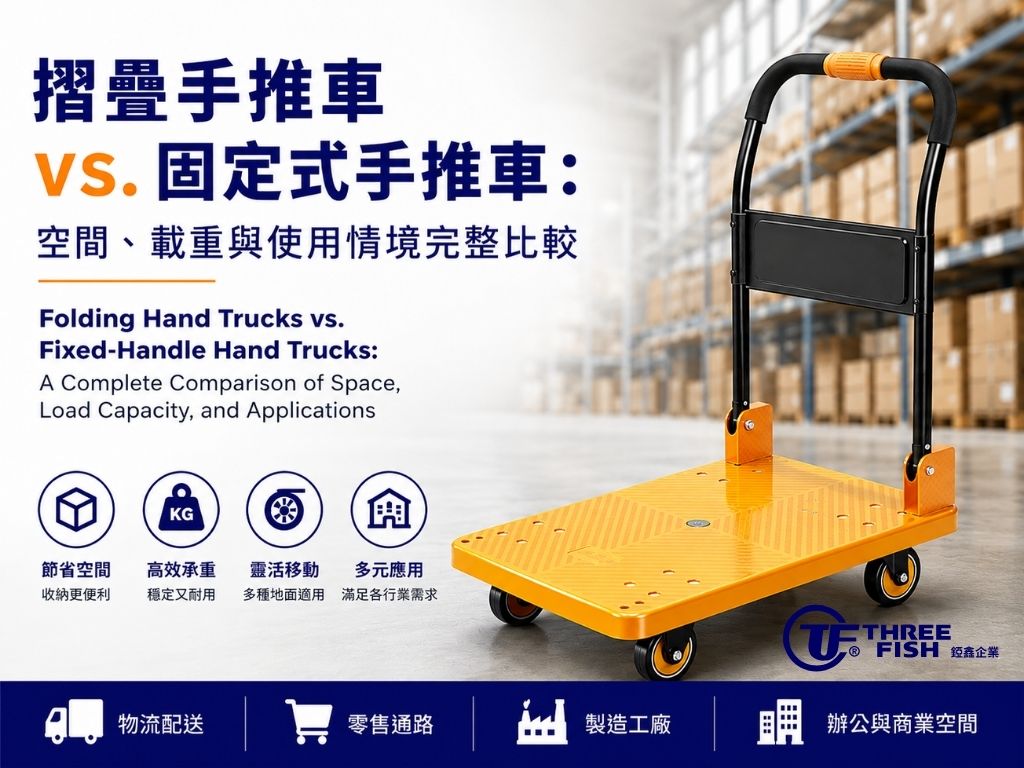
Introduction: Is a Folding Design Really Better?
In logistics warehousing, factory material handling, retail stores, office spaces, and various commercial venues, platform carts are essential handling tools used almost every day. However, when enterprises prepare to purchase new material handling equipment, they often face a critical question: should they choose a folding platform cart, or a fixed platform cart?
Many believe that a folding platform cart merely adds a collapsibility feature with no significant difference in actual usage. However, when evaluating structural design, load capacity, storage efficiency, usage frequency, and applicable environments, folding and fixed platform carts each have highly specific market positionings. If the selected type does not align with the actual operational workflow, it can reduce handling efficiency and increase both equipment wear and operator fatigue.
For instance, logistics delivery personnel might prioritize whether the equipment fits into a vehicle cabin, deploys quickly, and is highly portable; whereas manufacturing plants are likely to prioritize structural rigidity, durability, and sustained heavy-load capabilities. These two scenarios demand entirely different cart specifications, meaning the decision cannot be based solely on price or folding capability.
From a practical application perspective, drawing on the extensive experience of Der Teng (TF Caster) in platform carts, hand trucks, roll cages, and industrial casters, this article deeply compares folding and fixed platform carts. This comprehensive guide will help you select the most suitable handling equipment based on load weight, usage frequency, storage space, and operational environment.
1. What is a Folding Platform Cart?
The defining feature of a folding platform cart is its handle or pushbar, which can be collapsed via a folding mechanism. This significantly reduces the overall volume, making it highly convenient for storage, carrying, and vehicular transport. When the equipment is temporarily not in use, it can be tucked away in warehouse corners, truck cabins, office storage rooms, or retail backrooms without occupying the floor footprint of a fully deployed cart.
This design is exceptionally suited for environments with flexible handling needs. For example, delivery personnel traveling to multiple locations daily need to easily load the cart into their trucks; retail stores may only use carts during specific restocking hours and require immediate storage afterward; exhibitions require rapid setup, teardown, and equipment transport within strict time limits. In these cases, the rapid deployment and collapse of folding carts greatly enhance equipment dispatch efficiency.
However, "foldable" does not mean all structural integrities are identical. The design of the folding joints, locking mechanisms, handle rigidity, platform materials, and caster configurations directly dictate actual durability and operational safety. If the folding mechanism lacks a robust positioning design, long-term use may result in joint clearance, wobbling, or stiff operation. Therefore, procurement should involve a holistic evaluation rather than merely checking the "foldability" box.
For work environments constrained by limited storage space, requiring cross-location usage, or involving intermittent operations, a folding platform cart typically strikes the optimal balance between handling performance and spatial efficiency.
2. Folding Platform Carts vs. Fixed Platform Carts
| Comparison Metric | Folding Platform Carts | Fixed Platform Carts |
|---|---|---|
| Storage Convenience | Handles fold quickly, minimizing the footprint required for parking and transport. | Requires dedicated parking space; not suited for environments requiring frequent stowage. |
| Structural Rigidity | Depends on folding joints and locking mechanisms; best for general to moderate handling needs. | Handles are rigidly welded/bolted to the chassis, typically offering superior overall structural integrity. |
| Load Capacity Profile | Available in various load specs, but selection must strictly adhere to product ratings and actual conditions. | Generally superior for high-frequency, long-duration, or heavy-duty load environments. |
| Transportability | Once folded, easily fits into vehicle trunks, elevators, or tight storage spaces. | Occupies significant 3D volume during transport. |
| Usage Frequency | Ideal for intermittent use, cross-zone transport, or scenarios requiring frequent storage. | Ideal for fixed workstations and continuous, prolonged operation. |
| Common Applications | Logistics delivery, retail restocking, exhibitions, office spaces, and service sectors. | Manufacturing plants, logistics hubs, production lines, warehousing, and high-frequency handling. |
As the comparison illustrates, the primary advantage of folding carts lies in storage and transport convenience, whereas fixed carts excel in structural stability for high-frequency usage. Neither is inherently superior; the true deciding factor is your operational workflow.
If your daily operations involve continuously handling massive volumes of goods within a fixed facility, the fixed structural design naturally aligns better with your needs. Conversely, if the equipment must transit across floors, multiple sites, or travel inside a vehicle—and requires immediate stowage after use—a folding platform cart effectively maximizes spatial efficiency.
Many enterprises view the folding mechanism merely as an add-on feature, but from a facility management perspective, it directly impacts spatial layout. For instance, storing multiple carts in a single zone is vastly more efficient when handles are collapsed, reducing the clearance needed between units, keeping transit aisles clear, and facilitating centralized dispatch.
3. When to Choose a Folding Platform Cart ?
Folding platform carts demonstrate distinct advantages when work environments demand frequent equipment relocation, vehicular delivery, temporary usage, or immediate post-use stowage.
Logistics Distribution and Field Handling
Delivery personnel transport goods to various client sites daily, requiring the cart to travel with the vehicle. An un-foldable handle monopolizes valuable cargo space and obstructs other freight. Folding carts instantly minimize their volume after use, significantly improving cargo area utilization.
Retail Stores and Department Store Restocking
Retail aisles and backroom spaces are typically confined. Carts are generally only deployed during dedicated restocking windows. Once restocking concludes, folding carts can be instantly stowed to avoid blocking customer pathways or operational zones, maintaining a pristine commercial environment.
Exhibitions and Temporary Projects
Move-in and teardown schedules at exhibitions are notoriously tight. Crews must swiftly transport displays, equipment, and materials. Folding carts are easy to transport in crew vans and can be centralized rapidly after use, making them perfect for temporary operations with high equipment turnover.
Offices, Schools, and Public Spaces
Moving documents, IT equipment, books, or event supplies is usually an intermittent task. Foldable designs eliminate the need for dedicated parking footprints during downtime, perfectly suiting offices, libraries, educational institutions, and public facilities.
Therefore, the crux of selecting a folding cart isn't just about "saving space," but evaluating whether the handling equipment needs to rapidly transition between operating, transporting, and storing states.
4. When to Choose a Fixed Platform Cart ?
If material handling involves high frequencies, heavy payloads, or a standardized workflow, fixed platform carts leverage their structural superiority to maximum effect.
For example, in manufacturing plants, assembly lines, logistics centers, and large-scale warehouses, vast quantities of materials are moved continuously. Carts remain in active operation for the majority of the shift and rarely require compact storage. Under these conditions, the rigidly welded/bolted connection between the handle and the platform forms a comprehensive load-bearing structure, providing vastly superior tactile control.
When transporting heavy loads, operators constantly push, pull, steer, and dock the cart. The handle of a fixed cart, devoid of folding joints, is highly resistant to lateral wobble, ensuring consistent and stable maneuvering performance even under prolonged mechanical stress.
If the handling environment features ramps, floor joints, long transit distances, or frequent loading/unloading, a fixed chassis alone is not enough. You must concurrently evaluate platform tensile strength, caster bracket thickness, wheel diameter, and brake configurations to engineer a complete and safe handling solution.
Ultimately, when spatial footprint is not the primary constraint—and structural rigidity, longevity, and high-frequency capabilities take precedence—a fixed platform cart is the objectively correct engineering choice.
5. Why Do Casters Affect Handling Efficiency ?
Buyers often focus entirely on platform dimensions, maximum load capacity, or foldability. However, practical field experience reveals that the most critical component dictating push effort and handling feedback is the caster configuration.
Even with an indestructible chassis, if the casters are mismatched with the payload, flooring, or usage frequency, operators will suffer from high start-up resistance, poor steering, excessive noise, rapid tread wear, or bracket deformation. In logistics centers or factories, a cart may be moved hundreds of times a day; the accumulation of minor rolling resistance translates directly into severe operator fatigue.
Wheel Diameter
Generally, larger wheel diameters traverse thresholds, floor joints, and minor debris with far less resistance, dampening impacts from uneven terrain. For long-distance transport or sub-optimal floor conditions, wheel diameter must not be compromised for cost or aesthetic reasons.
Swivel and Rigid Caster Configurations
Swivel casters (Universal) excel in tight-space maneuverability, while rigid casters (Directional) maintain straight-line tracking. Industrial carts typically pair both to balance steering agility with straight-line stability. Equipping a cart exclusively with swivel casters allows 360-degree freedom but demands continuous directional correction from the operator over long distances.
Tread Material and Operating Environment
Different floorings, load classes, and environmental conditions demand specific wheel treads and bracket materials. Indoor commercial spaces prioritize acoustic dampening and floor protection (e.g., TPR); logistics hubs demand extreme wear resistance and load-bearing strength (e.g., PU/Nylon); food processing or high-humidity environments necessitate specialized corrosion resistance.
Braking and Anchoring Capabilities
A cart must not only move smoothly but also anchor reliably during cargo transfers or idle periods. An appropriate brake mechanism mitigates the risk of the cart rolling away due to slight inclines, accidental impacts, or external forces, establishing a baseline for operational safety.
For enterprises, optimizing caster configurations does more than improve operator ergonomics; it directly decreases maintenance frequency, extends the cart's lifecycle, and optimizes long-term material handling economics.
6. Five Easily Overlooked Details When Buying Folding Carts
1. Fixating on Max Load While Ignoring Actual Conditions
Maximum load capacity is merely a baseline. You must evaluate whether the cargo weight is centralized or dispersed, if the floor is level, if threshold crossings are frequent, and if the handling process generates dynamic impact loads. Consistently operating near the maximum threshold accelerates wear on the platform, folding joints, and casters. Always incorporate a reasonable safety margin based on actual payload weight.
2. Failing to Verify Platform Size and Cargo Center of Gravity
An undersized platform causes cargo overhang, increasing the risk of sliding or unbalanced loading; an oversized platform unnecessarily balloons equipment volume and turning radius requirements. Beyond L×W dimensions, assess the cargo's center of gravity, rolling tendencies, and whether strapping/anti-slip designs are necessary.
3. Ignoring Actual Folded Dimensions
The core value of a folding cart is storage convenience, yet post-folding thickness, height, and footprint vary wildly across products. If the primary goal is fitting the cart into a delivery truck, under a counter, or in a narrow storage closet, strictly verify the folded dimensional specifications prior to procurement.
4. Mismatching Casters to Flooring and Routes
Smooth indoor flooring, factory concrete, tiled joints, and outdoor asphalt pose distinct tribological demands on casters. Undersized wheels or incorrect tread materials amplify rolling resistance, acoustic noise, and vibration. The entire transit route must be mapped during the selection phase.
5. Disregarding Maintenance and Part Replacement
For high-frequency carts, casters, brakes, and folding joints are consumable wear parts requiring periodic inspection. If a product lacks transparent structural documentation, or if OEM parts are difficult to source, future downtime and maintenance costs will spike. Comprehensive product data and robust supplier technical support are paramount.
7. How to Choose the Right Cart by Industry ?
Material handling workflows and environmental constraints vary drastically across industries. There is no "one-size-fits-all" platform cart. Enterprises must conduct a holistic evaluation based on usage frequency, stowage methods, cargo characteristics, and transit routes.
Logistics and Distribution
Delivery equipment constantly transitions between trucks, elevators, and multiple floors. Rapid deployment, high portability, and cabin space conservation are critical. Provided the load capacity and platform size are adequate, folding platform carts dramatically enhance the agility of field distribution.
Retail Channels and Department Stores
Restocking equipment is utilized strictly during specific time windows and must maintain the pristine appearance of customer aisles and backrooms. Foldable designs allow immediate stowage post-restocking, freeing up commercial real estate and streamlining centralized equipment management.
Manufacturing Plants and Logistics Centers
These environments require continuous, high-frequency material transport where structural durability is paramount. If stowage is not required, fixed platform carts are objectively superior. However, if workstation space is strictly limited and carts must be cleared post-operation, heavy-duty folding models can be evaluated based on load parameters.
Offices, Schools, and Public Institutions
Handling demands in these facilities are typically intermittent (e.g., moving archives, IT hardware, or event supplies). Folding carts can be discreetly tucked into supply closets during downtime, seamlessly balancing functionality with space management.
Hospitality, Catering, and Service Sectors
Beyond raw handling efficiency, these sectors prioritize maneuverability, aesthetic appearance, sanitation ease, and acoustic control. Procurement must holistically evaluate platform materials, silent casters, braking systems, and stowage footprint, rather than defaulting to "foldability" as the sole metric.
8. Der Teng (TF Caster) Material Handling Solutions
With deep-rooted expertise in the industrial caster and material handling equipment sectors, Der Teng (TF Caster) engineers a comprehensive portfolio of platform carts, hand trucks, roll cages, and specialized handling apparatus. Our solutions seamlessly integrate tailored caster and braking configurations to align with specific workflows, payload demands, and environmental constraints.
Our products are extensively deployed across logistics warehousing, manufacturing and processing, retail networks, commercial facilities, and complex handling operations. Procurement teams can precisely spec platforms and caster configurations based on cargo dimensions, anticipated payloads, transit distances, floor topography, and storage protocols, ensuring the equipment perfectly mirrors field requirements.
Unlike suppliers offering rigid, single-chassis options, Der Teng leverages its extensive industrial caster portfolio and application engineering experience. We assist in selecting optimal wheel diameters, bracket metallurgy, steering mechanisms, and braking functions, striking the perfect engineering balance between mobility efficiency, operational safety, and lifecycle durability.
For enterprises requiring highly specialized material handling solutions, our technical team consults directly on equipment dimensions, operational methodologies, and environmental variables to engineer optimized product configurations, significantly mitigating downstream replacement and modification costs.
9. Frequently Asked Questions (FAQ)
Q1: Is the load capacity of a folding cart inherently lower than a fixed cart ?
Not necessarily. Both folding and fixed platform carts are engineered to various load specifications. Actual load-bearing capacity is dictated by the platform metallurgy, chassis design, folding mechanism robustess, and caster ratings. However, for continuous high-load or extreme-frequency operations, a fixed structure inherently offers superior fatigue resistance. Always reference official product ratings and align them with actual operational conditions.
Q2: Are folding platform carts prone to damage ?
High-quality folding carts matched to correct specifications deliver exceptionally stable performance under normal operating conditions. Lifecycle longevity correlates directly with applied payloads, usage frequency, joint mechanism quality, caster integrity, and routine preventative maintenance. Eliminating overloading, abusive handling, and inspection neglect will drastically extend equipment life.
Q3: Which industries benefit most from folding platform carts ?
Logistics distribution, retail operations, department store restocking, exhibition logistics, office complexes, educational institutions, and any facility requiring frequent equipment stowage or cross-site transport should prioritize folding carts. Conversely, 24/7 heavy-load operations should lean toward fixed configurations.
Q4: Can the casters on a folding cart be replaced ?
This depends on the product's chassis engineering and mounting interfaces. During procurement, verify caster specifications, mounting plate dimensions (e.g., Top Plate/Threaded Stem), and long-term part availability to ensure you can swap casters in response to changing floor conditions, load variations, or standard maintenance cycles.
Q5: Do folding carts require braking systems ?
If the cart is utilized on inclined planes, requires anchoring during loading/unloading, or operates in high-traffic personnel zones, a braking configuration is highly recommended. Purpose-built brakes mitigate the risk of unintended rolling, securing the load and protecting personnel during stationary operations.
Q6: How much "safety margin" should be factored into load capacity when selecting a folding cart ?
Load capacity must be evaluated holistically against product specifications, static cargo weight, center of gravity, floor conditions, and dynamic handling impacts. Operating continuously at the maximum rated threshold is poor engineering practice. If transport routes involve expansion joints, ramps, or uneven terrain, expanding the safety margin is critical to absorb structural and caster impact stresses.
10. Conclusion: Elevate Efficiency and Spatial Utilization
Folding and fixed platform carts possess distinct engineering advantages; there is no monolithic solution for every logistical scenario. If stowage efficiency, cross-zone mobility, and spatial utilization are paramount, folding carts align perfectly with your requirements. If continuous heavy-duty transport, high-frequency utilization, and absolute structural rigidity are non-negotiable, fixed platform carts represent the superior engineering choice.
Beyond the primary chassis structure, platform dimensions, payload distribution, caster configurations, braking mechanisms, and floor topography govern operational efficiency and equipment longevity. Comprehensive procurement must transcend superficial price comparisons or a simple "foldable vs. non-foldable" checklist; it must be deeply anchored in actual material handling workflows.
Der Teng (TF Caster) supplies a diversified ecosystem of platform carts, folding hand trucks, roll cages, and professional-grade industrial casters, offering specialized configuration consulting tailored to varied industries, handling demands, and operational environments. If you are architecting new material handling infrastructure or seeking to optimize the efficiency of your current fleet, contact Der Teng (TF Caster) today. Let our engineering team help you architect the ultimate material handling solution tailored to your exact operational realities.